

The client will not approve the artwork: what to check before another revision
Investigate unclear criteria, missing decision authority and unanswered questions before revising again. Define responsibilities, revision rounds and feedback on the asset.
Written by the Aproova product team from the review flows we build and test in the application.

A third version, a fourth round, and the response is still ‘not quite right’. The team repeats work while cost and delay grow. Before assuming that taste is the problem, ask what the client still needs to make a decision.
Three points deserve checking: a brief without clear success criteria, comments from someone who cannot give final approval, and a decision awaiting information or internal agreement. Each requires a different response; another version may be necessary, but it does not replace that diagnosis.
This guide explains how to investigate those blockers and adjust the process before opening another round.
Check whether the brief defines a successful result
A request for ‘something modern and eye-catching’ leaves room for conflicting interpretations. Specify the audience, channel, approved references and message the asset must communicate. Without those criteria, both the request and rejection can remain vague.
Return to the agreement before changing the file. What must the asset achieve? Which examples does the client consider successful? What cannot change, such as brand rules, required wording or price? Confirm those answers, then decide whether another revision is needed.
Separate people who comment from people who decide
The coordinator likes the work and the team comments, but a decision-maker sees it only at the end and rejects it. Earlier feedback may still be useful; the missing step is confirming who can authorize the final result and involving that person at the right point.
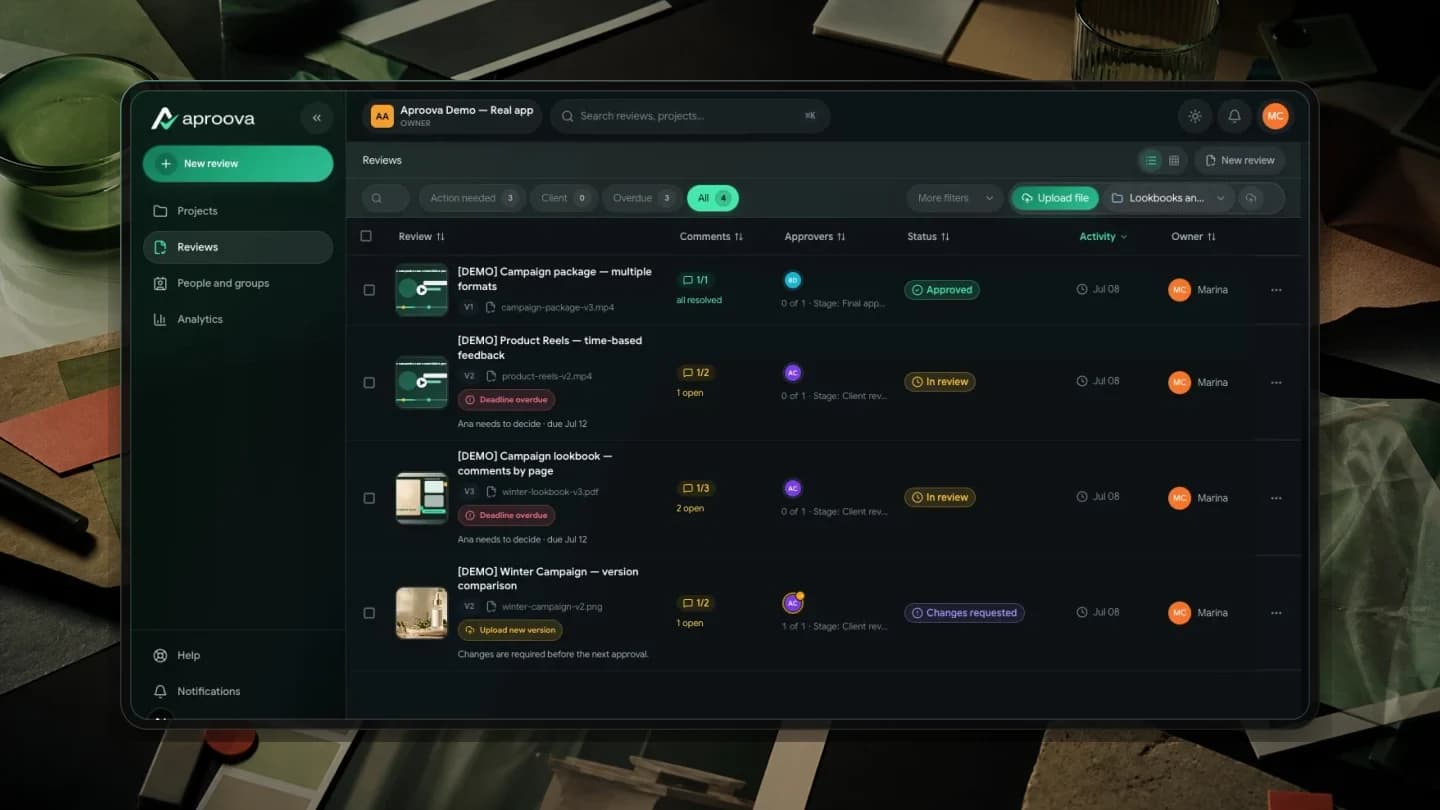
Name the approver at the start and clarify roles. Aproova distinguishes commenters from approvers in a review phase: a commenter contributes feedback, while an approver can also record a decision. Check who participates and what each person is allowed to do.
Ask what is missing before the decision can be made
‘Let me show one more person’ may indicate a required consultation, missing information or uncertainty about responsibility. Do not infer the client's motives. Ask whose input is needed, what question remains and when the group can decide.
When useful, present two feasible options and explain each in one sentence. State the consequences and constraints, then record the chosen direction with the responsible person and date. A clear record shows what was authorized; it does not remove the need to resolve the underlying question.
Agree revision rounds and consolidate feedback
Define the included rounds and the treatment of additional work before starting. Two included rounds can be an example for discussion, not a universal standard. Extra charges depend on the agreed scope and terms; recording a request alone does not authorize a charge.
Ask for all comments for the round on the relevant areas of the asset. If the response is ‘I don't like it’, ask what does not meet the agreed criteria. ‘This headline competes with the logo; make it smaller’ is actionable. Consolidate conflicting requests before preparing the next version.
Questions people ask before setting up the workflow
How many revision rounds are reasonable?
There is no universal number in this guide. Consider the work's complexity, the participants and the agreed scope. Two included rounds can be a starting proposal, with additional work agreed separately. Repeated rejections also call for a review of the brief and decision authority.
How can we discuss out-of-scope changes without damaging the relationship?
Use the agreed scope and review history to explain what changed. Record the request, its effect on time and cost, and seek agreement before extra work. The record supports the conversation; it does not replace the agreed terms or guarantee acceptance of a charge.
What if several people on the client side give feedback?
Bring the authorized participants into the same review, collect their comments on the asset and ask the named approver to consolidate the decision. Resolve contradictions explicitly. Comments arriving through several channels should be connected to the correct version before work starts.
Continue with these guides
Social post approval: from artwork review to scheduling
Follow a carousel through slide comments, a new version, the client's decision and the final checks before scheduling.
Read guide
Approval platforms: language, client access and purchasing terms
Assess language, client access, versions, history and purchasing terms before choosing an approval platform.
Read guide
Online proofing for agencies: how it works and when it helps
Learn how online proofing connects comments, versions and campaign approval across designers, account managers and clients.
Read guide